← back to the catalogue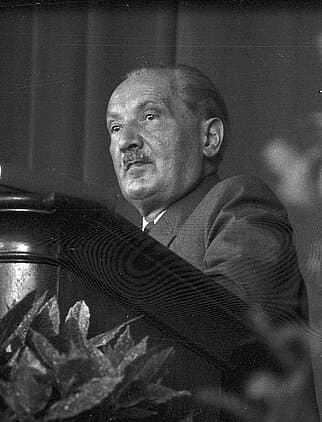
› reshelve this entry
See something off? The librarian reads these on Sundays. Wrong cover, wrong details, a duplicate of another entry — let us know and we’ll sort it.
Author file · 01281
Martin Heidegger
1889–1976
On Martin Heidegger
A brief life
Martin Heidegger was born in 1889 in Messkirch, Germany, and died in 1976 in Freiburg. He spent his academic career primarily at the University of Freiburg, where he became a central figure in 20th-century continental philosophy. His life was deeply marked by his controversial tenure as rector of the university during the rise of the Nazi regime.
On the page
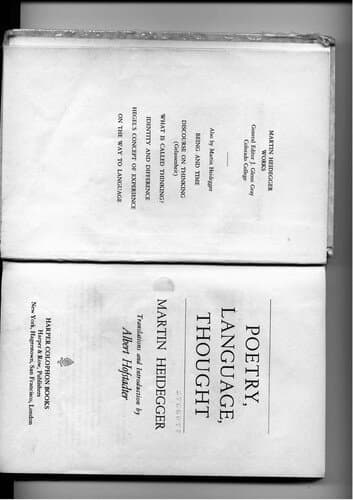
His seminal work, Being and Time, published in 1927, sought to reorient philosophy toward the fundamental question of existence. His later writings, including Poetry, Language, Thought and The Question Concerning Technology, shifted toward an examination of language, art, and the encroaching dominance of modern technical rationality. He consistently rejected traditional metaphysics in favor of a phenomenology of human being.
In their time
Heidegger's work garnered immediate, intense academic interest, establishing him as a successor to Edmund Husserl. While his early lectures drew massive student followings, his political affiliations led to significant professional ostracization and long-standing debates regarding the relationship between his philosophy and his ideology.
The afterlife
Heidegger remains one of the most influential and polarizing thinkers of the modern era, profoundly shaping existentialism, deconstruction, and hermeneutics. His concepts of Dasein and the critique of technological enframing continue to inform contemporary discourse in architecture, literary theory, and environmental ethics.
Works in the catalogue · 2 entered
The collected
1 copy on offer
Poetry, Language, Thought
1 copy on offer
Preoccupied with
Recurring motifs



In conversation with