← back to the catalogue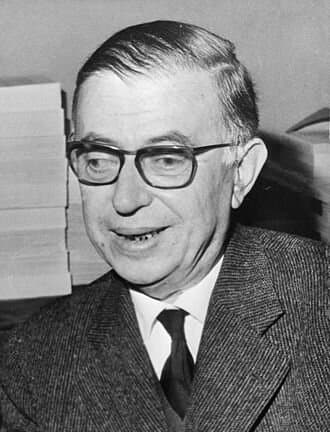
› reshelve this entry
See something off? The librarian reads these on Sundays. Wrong cover, wrong details, a duplicate of another entry — let us know and we’ll sort it.
Author file · 01201
Jean-Paul Sartre
1905–1980
On Jean-Paul Sartre
A brief life
Jean-Paul Sartre was born in Paris in 1905 and died there in 1980, having spent his life as the preeminent intellectual figure of the French twentieth century. Educated at the École Normale Supérieure, he served in the French army during the Second World War and spent time as a prisoner of war before returning to Paris to participate in the Resistance. His lifelong partnership with Simone de Beauvoir anchored a career defined by radical political engagement and public intellectualism.
On the page
Sartre’s body of work spans dense philosophical treatises, novels, plays, and critical essays. His seminal philosophical work, Being and Nothingness, established the foundations of existentialism, while his novel Nausea and the play No Exit dramatized the concepts of radical freedom and the burden of existence. He produced extensive biographies on Baudelaire, Genet, and Flaubert, consistently exploring the intersection of individual agency and historical circumstance.
In their time
Sartre achieved immense fame during his lifetime, becoming a global celebrity whose public pronouncements carried significant political weight. While his literary and philosophical output was met with both intense admiration and rigorous critique from contemporaries like Albert Camus and Maurice Merleau-Ponty, his influence remained largely unchallenged. He famously declined the Nobel Prize in Literature in 1964, citing his desire to remain independent of all institutional honors.
The afterlife
Sartre’s legacy persists as the primary architect of modern existentialist thought, shaping the trajectory of continental philosophy and literary theory. His insistence on the necessity of political commitment for the writer continues to inform debates regarding the role of the intellectual in society. His works remain essential reading for those investigating the nature of consciousness, freedom, and the ethics of the individual in a godless world.
Works in the catalogue · 2 entered
The collected
1 copy on offer
Preoccupied with
Recurring motifs



In conversation with