← back to the catalogue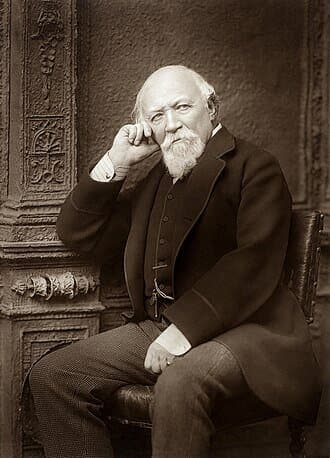
› reshelve this entry
See something off? The librarian reads these on Sundays. Wrong cover, wrong details, a duplicate of another entry — let us know and we’ll sort it.
Author file · 05286
Robert Browning
1812–1889
On Robert Browning
A brief life
Robert Browning was born in Camberwell, London, in 1812 and spent his most productive years in Italy following his elopement with Elizabeth Barrett. He remained a fixture of the Victorian literary scene until his death in Venice in 1889. His life was defined by his deep immersion in Renaissance history and his lifelong devotion to his wife’s memory.
On the page
Browning is the undisputed master of the dramatic monologue, a form he perfected in collections such as Dramatic Lyrics and the monumental verse-novel The Ring and the Book. His poetry is characterized by a rugged, conversational rhythm, psychological complexity, and an obsession with the moral ambiguity of historical figures. He eschewed the lyrical sentimentality of his contemporaries in favor of jagged, intellectual realism.
In their time
Initial reception of his work was notoriously difficult, with critics often labeling his style as obscure, harsh, and overly demanding of the reader. It was not until the publication of Men and Women and Dramatis Personae that he began to achieve genuine critical and popular acclaim. By the end of his life, he was celebrated as a sage and a central pillar of English literature, leading to the formation of dedicated Browning Societies.
The afterlife
Browning’s influence on the development of modernism is profound, as his use of the unreliable narrator and fragmented consciousness paved the way for T.S. Eliot and Ezra Pound. He remains a vital subject of study for his radical experimentation with voice and his ability to inhabit the minds of the morally compromised. His work continues to be read as the definitive bridge between Victorian moralism and the psychological interiority of the twentieth century.
1 volume cataloguedWikipedia ↗
Works in the catalogue · 1 entered
The collected
1 copy on offer
Preoccupied with
Recurring motifs



In conversation with