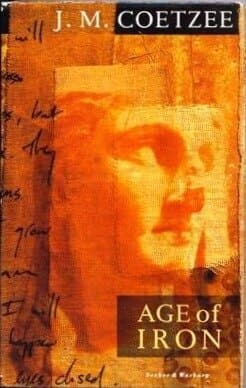
Age of Iron
J. M. Coetzee · 1990
Books from independent sellers worldwide
See something off? The librarian reads these on Sundays. Wrong cover, wrong details, a duplicate of another entry — let us know and we’ll sort it.
Author file · 04666
1940–
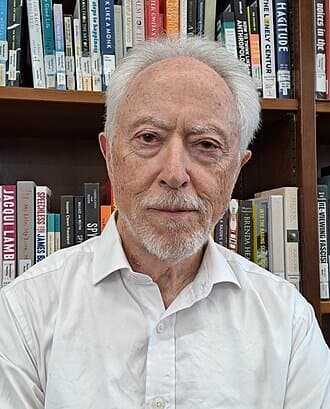
On J. M. Coetzee
A brief life
John Maxwell Coetzee was born in 1940 in Cape Town, South Africa, and spent his formative years oscillating between his home country and academic posts in the United States and Australia. He eventually settled in Adelaide, where he became an Australian citizen in 2006. His life is defined by a rigorous, ascetic commitment to the intellectual life and a profound withdrawal from the public sphere.
On the page
Coetzee’s bibliography is marked by a stark, minimalist prose style that interrogates power, colonial guilt, and the ethics of human-animal relations. His most celebrated works include the allegorical 'Waiting for the Barbarians', the brutal 'Life & Times of Michael K', and the meta-fictional 'Elizabeth Costello'. His later work often engages in complex experiments with autobiography and the nature of the novel itself.
In their time
He achieved international acclaim early in his career, becoming the first author to win the Booker Prize twice, first for 'Life & Times of Michael K' and later for 'Disgrace'. While his work was sometimes criticized in South Africa for its perceived pessimism regarding the post-apartheid transition, global critics lauded his moral precision and stylistic austerity. He was awarded the Nobel Prize in Literature in 2003.
The afterlife
Coetzee stands as one of the most significant figures in late 20th and early 21st-century literature, exerting a profound influence on writers concerned with the ethics of representation. His work remains a cornerstone of post-colonial studies and contemporary philosophical fiction. He is widely regarded as a master of the unsparing, intellectual novel.
Works in the catalogue · 1 entered
J. M. Coetzee · 1990
1 copy on offer
Preoccupied with
In conversation with