← back to the catalogue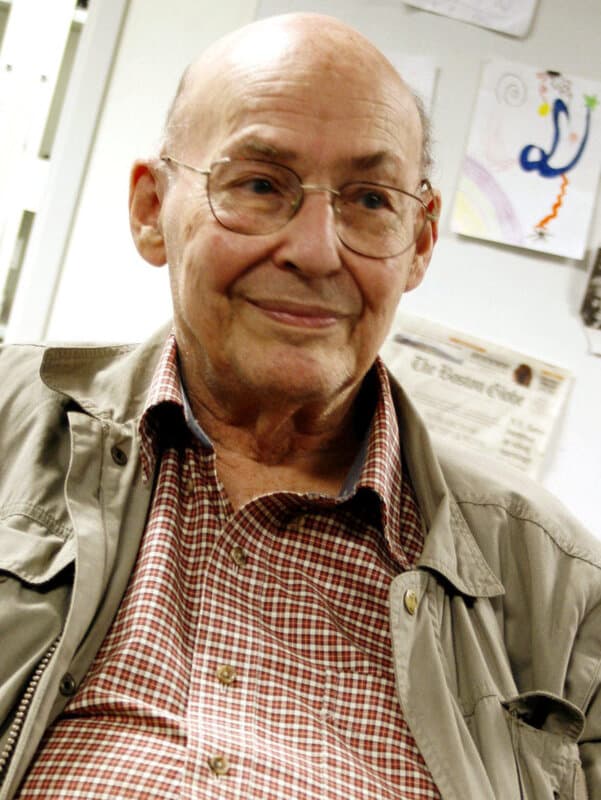
› reshelve this entry
See something off? The librarian reads these on Sundays. Wrong cover, wrong details, a duplicate of another entry — let us know and we’ll sort it.
Author file · 01916
Marvin Minsky
1927–2016
On Marvin Minsky
A brief life
Born in New York City in 1927, Marvin Minsky was a polymath who served as a professor of electrical engineering and computer science at MIT for over five decades. He was a pioneer in the field of artificial intelligence, co-founding the MIT AI Laboratory in 1959. His intellectual life was defined by a restless curiosity that spanned cognitive psychology, mathematics, and the philosophy of mind.
On the page
Minsky's seminal texts, including 'Computation: Finite and Infinite Machines' and 'The Society of Mind', fundamentally altered the trajectory of computer science. He argued that human consciousness is an emergent property of simple, non-intelligent processes, a theory he developed through rigorous mathematical modeling and cybernetic inquiry. His writing is characterized by a blend of technical precision and speculative, often provocative, philosophical inquiry.
In their time
During his lifetime, Minsky was celebrated as a visionary, receiving the Turing Award in 1969 for his contributions to the field. While his work was foundational, it occasionally sparked intense debate, particularly regarding the feasibility of his 'Society of Mind' architecture and the limitations of connectionist models in the late 20th century. His influence was pervasive in academic circles, though his more philosophical writings often challenged the boundaries of traditional scientific discourse.
The afterlife
Minsky remains a towering figure in the history of cognitive science and robotics, with his concepts providing the bedrock for modern neural network research and machine learning. His insistence on the mechanistic nature of intelligence continues to inform current debates regarding the ethics and future of artificial intelligence. His books remain essential reading for those interested in the intersection of biology, logic, and the architecture of thought.
Works in the catalogue · 2 entered
The collected
1 copy on offer
The Society of Mind
1 copy on offer
Preoccupied with