← back to the catalogue
› reshelve this entry
See something off? The librarian reads these on Sundays. Wrong cover, wrong details, a duplicate of another entry — let us know and we’ll sort it.
Author file · 01496
Clive Barker
1952–
On Clive Barker
A brief life
Clive Barker was born in 1952 in Liverpool, England, and studied English and Philosophy at the University of Liverpool. He emerged from the British horror scene of the 1980s as a polymath, balancing a prolific career as a novelist, playwright, and visual artist. His move to Los Angeles in the 1990s marked a transition toward more cinematic and expansive myth-making.
On the page
Barker’s work is defined by the intersection of visceral body horror and metaphysical wonder, most notably in his six-volume collection 'Books of Blood' and the novella 'The Hellbound Heart'. His later novels, such as 'Imajica' and 'Weaveworld', shifted toward high-fantasy epics that maintain his signature focus on the hidden, grotesque, and transcendent layers of reality. He consistently explores the thin veil between human desire and monstrous suffering.
In their time
Upon the release of 'Books of Blood', Barker was famously hailed by Stephen King as the future of horror. While his early work faced censorship and controversy for its extreme graphic content, he quickly gained a cult following that evolved into mainstream literary recognition. Critics often praised his prose for its lush, painterly quality, distinguishing him from the more utilitarian style of his genre contemporaries.
The afterlife
Barker is credited with elevating the horror genre by infusing it with sophisticated theological and philosophical inquiry. His influence persists in the aesthetic of modern dark fantasy and the continued adaptation of his iconography into film and graphic novels. He remains a singular figure whose work bridges the gap between pulp fiction and literary surrealism.
Works in the catalogue · 2 entered
The collected
1 copy on offer
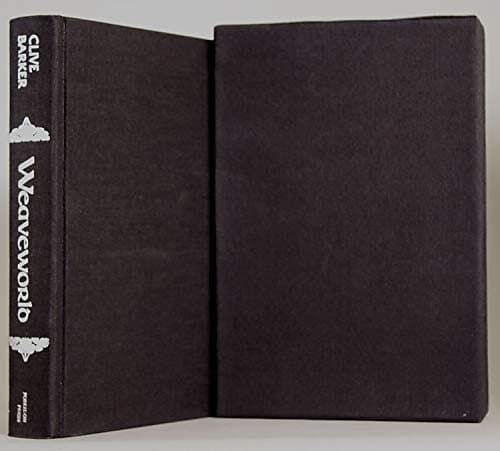
Weaveworld
Clive Barker · 1987
1 copy on offer
Preoccupied with
Recurring motifs



In conversation with