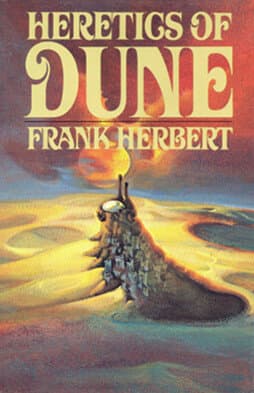
Heretics of Dune
Frank Herbert · 1984
Books from independent sellers worldwide
See something off? The librarian reads these on Sundays. Wrong cover, wrong details, a duplicate of another entry — let us know and we’ll sort it.
Author file · 01173
1920–1986
On Frank Herbert
A brief life
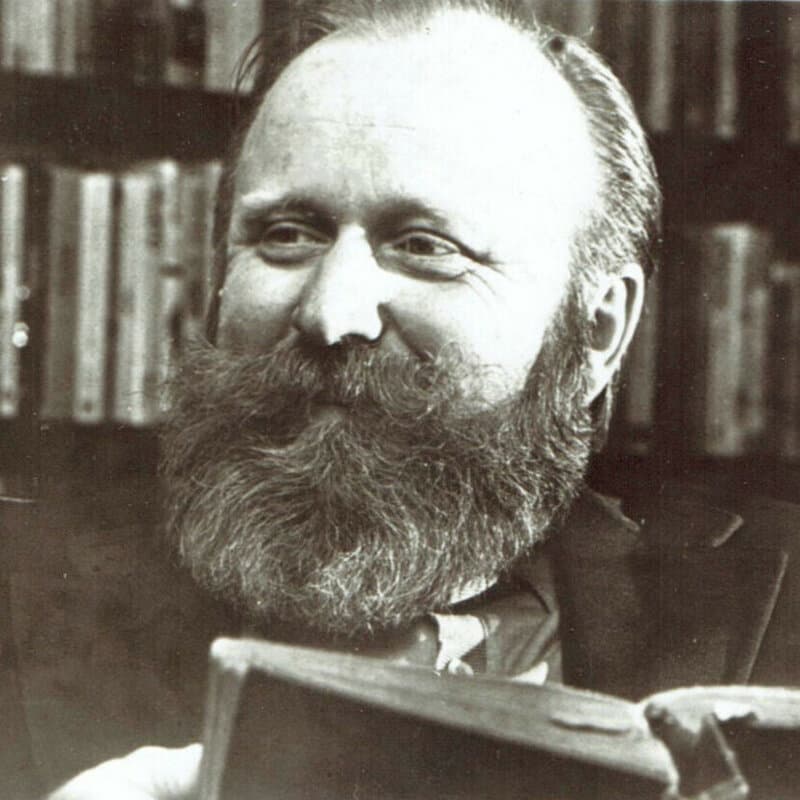
Frank Herbert was born in 1920 in Tacoma, Washington, and spent his early adulthood working as a journalist and news editor across the Pacific Northwest. His deep immersion in the ecology of the Oregon dunes served as the primary catalyst for his most famous literary creation. He died in 1986, shortly after the publication of the final volume in his primary saga.
On the page
Herbert is best known for the Dune series, a sprawling epic that synthesizes planetary ecology, feudal politics, and messianic religion. His bibliography also includes significant works of speculative fiction such as The Dosadi Experiment and The White Plague, which explore the limits of human consciousness and the dangers of unchecked technological power. His prose is characterized by dense world-building and a relentless focus on the evolution of societal structures.
In their time
Dune was initially rejected by over twenty publishers before being accepted by Chilton, a company primarily known for automotive repair manuals. Upon its 1965 release, it received the inaugural Nebula Award and shared the Hugo Award, cementing its status as a masterpiece of science fiction despite early criticism regarding its dense, jargon-heavy narrative style.
The afterlife
Herbert’s influence on the science fiction genre is foundational, having redefined the scope of space opera by integrating complex environmental and philosophical inquiries. His work remains a staple of the literary canon, with the Dune universe continuing to expand through film adaptations and ongoing scholarly analysis of his prophetic themes.
Works in the catalogue · 2 entered
Frank Herbert · 1984
2 copies on offer
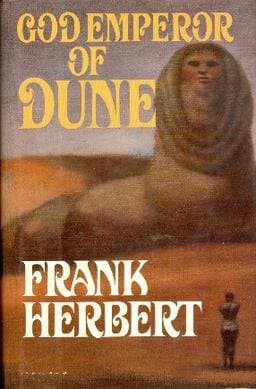
Frank Herbert · 1981
1 copy on offer
Preoccupied with
In conversation with