› reshelve this entry
See something off? The librarian reads these on Sundays. Wrong cover, wrong details, a duplicate of another entry — let us know and we’ll sort it.
Author file · 05397
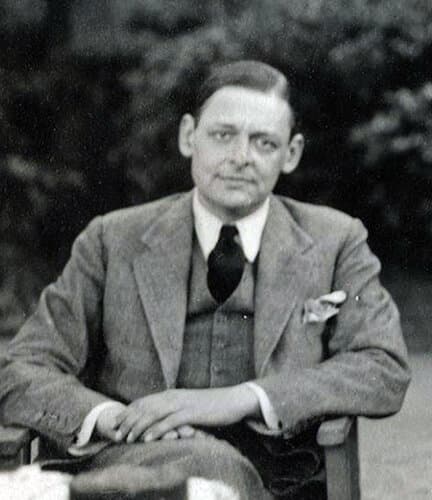
T. S. Eliot
1888–1965
On T. S. Eliot
A brief life
Thomas Stearns Eliot was born in St. Louis, Missouri, in 1888 and later relocated to England, where he became a British subject in 1927. His intellectual formation at Harvard, the Sorbonne, and Oxford provided the rigorous philosophical foundation for his modernist experimentation. He spent much of his professional life working as an editor at Faber & Faber, where he exerted immense influence over the trajectory of 20th-century literature.
On the page
Eliot’s body of work is defined by a radical departure from Victorian sentimentality, favoring complex allusion, polyphonic structure, and fragmented narratives. His seminal poems, including The Waste Land and Four Quartets, explore the tension between spiritual emptiness and the search for transcendent meaning. His later career shifted toward verse drama, most notably Murder in the Cathedral and The Cocktail Party, which sought to reconcile classical Greek form with Christian theology.
In their time
The publication of The Waste Land in 1922 established Eliot as the preeminent voice of the modernist movement, though his work was initially met with both profound bewilderment and critical hostility. While his technical mastery was rarely questioned, his perceived elitism and dense, scholarly references made his work a lightning rod for debate. He was awarded the Nobel Prize in Literature in 1948, cementing his status as a titan of the literary establishment.
The afterlife
Eliot remains the defining architect of modern English poetry, having fundamentally altered the way subsequent generations approach the lyric form. His critical essays, particularly those on the 'objective correlative' and the 'dissociation of sensibility,' continue to serve as essential texts for literary theorists. His influence persists not only in the work of his immediate successors but in the enduring academic and cultural obsession with his complex, layered verse.
Works in the catalogue · 0 entered
The collected
No works yet entered for this author.
Preoccupied with
Recurring motifs


In conversation with