› reshelve this entry
See something off? The librarian reads these on Sundays. Wrong cover, wrong details, a duplicate of another entry — let us know and we’ll sort it.
Author file · 00439
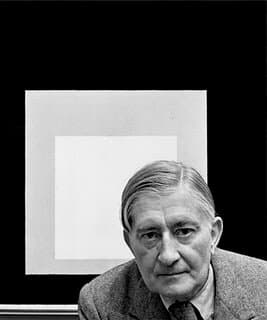
Josef Albers
1888–1976
On Josef Albers
A brief life
Josef Albers was born in Bottrop, Germany, in 1888 and died in New Haven, Connecticut, in 1976. After his formative years at the Bauhaus, he emigrated to the United States in 1933 to escape the Nazi regime, subsequently leading the art department at Black Mountain College and later Yale University.
On the page
Albers is best known for his rigorous, decades-long series 'Homage to the Square,' which systematically explored the interaction of color through nested geometric forms. His seminal text, 'Interaction of Color,' serves as the definitive pedagogical framework for understanding how visual perception alters the appearance of hue, value, and intensity. His work consistently prioritized the economy of means, favoring precise mathematical relationships over expressive gesture.
In their time
During his lifetime, Albers was celebrated as a foundational figure of modernism and a master of color theory, though his austere, non-representational approach occasionally faced criticism from those who favored the emotional spontaneity of Abstract Expressionism. His influence as an educator was profound, shaping generations of American artists who sought a more analytical approach to abstraction. He received numerous retrospectives, including a major exhibition at the Museum of Modern Art in 1971.
The afterlife
Albers remains a cornerstone of 20th-century art history, his theories on color perception continuing to inform both fine art practice and digital design. His commitment to the 'less is more' philosophy established the groundwork for Minimalism and Op Art. His work is held in major institutional collections worldwide, and his writings remain essential reading for students of visual culture.
Works in the catalogue · 0 entered
The collected
No works yet entered for this author.