› reshelve this entry
See something off? The librarian reads these on Sundays. Wrong cover, wrong details, a duplicate of another entry — let us know and we’ll sort it.
Author file · 03911
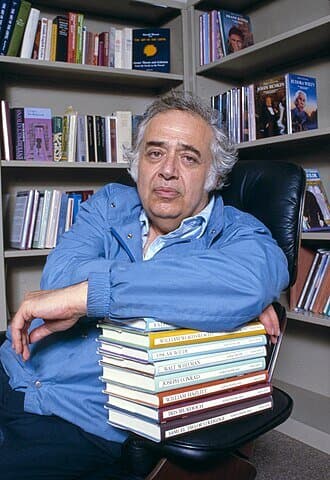
Harold Bloom
1930–2019
On Harold Bloom
A brief life
Harold Bloom was born in 1930 in New York City to Yiddish-speaking immigrant parents, a background that informed his lifelong devotion to the English literary canon. He spent the vast majority of his professional life at Yale University, where he became a towering and often polarizing figure in American letters. He died in 2019, having spent his final decades as a prolific author and public intellectual.
On the page
Bloom’s body of work, including The Anxiety of Influence, The Western Canon, and Shakespeare: The Invention of the Human, centers on the concept of the 'strong poet' struggling against the weight of literary precursors. He championed a subjective, aesthetic approach to reading, prioritizing the 'greatness' of individual writers over ideological or historical contextualization. His writing is characterized by a dense, idiosyncratic style and an encyclopedic command of the English poetic tradition.
In their time
During his lifetime, Bloom was a lightning rod for academic controversy, frequently clashing with the rise of post-structuralism, feminism, and Marxism in literary studies. While he was celebrated by the general public and traditionalist critics as a champion of high culture, he was often dismissed by academic departments as an elitist who ignored the political dimensions of literature. His work consistently topped bestseller lists for literary criticism, marking a rare crossover success for a scholar.
The afterlife
Bloom remains the most recognizable face of 20th-century literary criticism, remembered for his uncompromising defense of the aesthetic experience. His influence persists in the way literature is taught and discussed in the public sphere, particularly his insistence on the centrality of William Shakespeare. He left behind a vast bibliography that serves as a map for readers navigating the complexities of the Western literary tradition.
Works in the catalogue · 0 entered
The collected
No works yet entered for this author.
In conversation with