› reshelve this entry
See something off? The librarian reads these on Sundays. Wrong cover, wrong details, a duplicate of another entry — let us know and we’ll sort it.
Author file · 01429
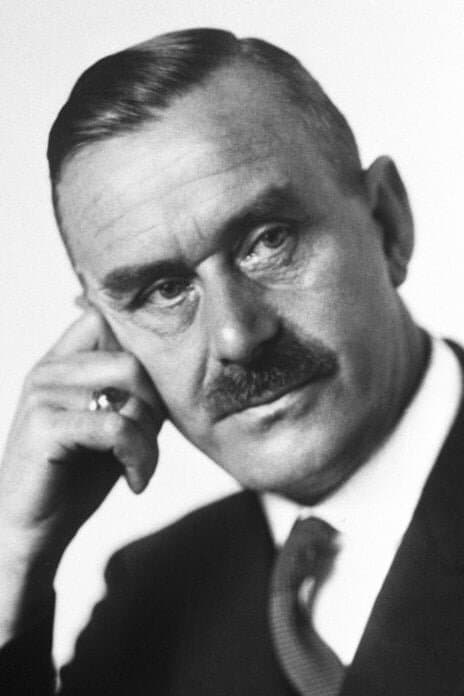
Thomas Mann
1875–1955
On Thomas Mann
A brief life
Thomas Mann was born in 1875 in Lübeck, Germany, and died in 1955 in Kilchberg, Switzerland. The son of a wealthy merchant, he spent his formative years navigating the tension between bourgeois stability and artistic vocation. Following the rise of the National Socialist regime, he went into exile, living in France, Switzerland, and eventually the United States before returning to Europe after the war.
On the page
Mann’s oeuvre is defined by the dialectic between intellectual rigor and physical decay, most notably in Buddenbrooks, The Magic Mountain, and Death in Venice. His prose is characterized by elaborate, ironic syntax and a preoccupation with the decline of European humanism. He frequently utilized the mythic structure to examine the psychological burdens of the modern artist.
In their time
He achieved early, massive commercial success with Buddenbrooks, which secured his status as a leading German novelist. The 1929 Nobel Prize in Literature cemented his international reputation, though his political evolution from a conservative nationalist to a vocal anti-fascist polarized his reception among German readers. His later work, particularly Doctor Faustus, was met with both profound intellectual admiration and intense debate regarding his critique of the German soul.
The afterlife
Mann remains the definitive chronicler of the European bourgeois collapse. His influence persists in the works of writers who grapple with the intersection of history, philosophy, and narrative form. He is viewed as the last great practitioner of the nineteenth-century realist tradition, transformed by twentieth-century irony.
Works in the catalogue · 0 entered
The collected
No works yet entered for this author.
Preoccupied with
Recurring motifs



In conversation with